Introduction
Most manufacturing companies in the construction sector lose track of their product the moment it leaves the warehouse. They know how much they produced, they know who they sold it to. They don’t know where it is installed, in what context, with what real performance, or what will happen when that component needs replacing or the building is demolished. This gap is not just an operational problem. It is a missed opportunity. European markets that require structured technical and environmental documentation are growing. DPP regulations – EU Regulation ESPR 2024/1781 and CPR 2024/3110 – set clear deadlines. Those who arrive with structured data in hand, when others are still figuring out what to do, hold a competitive advantage that is hard to recover. In Europe, some actors are already on this path: manufacturers, technology platforms, software houses, standardisation bodies. Here is who they are and what they are doing.
Structuring product data as a shared language
Cobuilder is a Norwegian company that has built infrastructure for structured product data management in construction. Its platform enables manufacturers to create, manage and distribute technical declarations – from product data sheets to performance declarations – in standardised, interoperable formats compatible with major BIM systems and European regulatory requirements. The problem it solves is concrete: a construction component manufacturer has technical documentation scattered across PDFs, Excel spreadsheets, printed data sheets and internal files that change version without the supply chain knowing. Cobuilder centralises this asset and makes it distributable in structured form. When a specifier looks for a product that meets a specific requirement, they find it – with the right data, in the right format. Manufacturers such as Rockwool, Knauf and Saint-Gobain use Cobuilder to manage their product declarations in markets where structured technical documentation is already an entry requirement, not an option.

Turning environmental data into a market tool
Prodikt is a French platform dedicated to environmental data for construction products. It enables manufacturers to structure, manage and publish their environmental product declarations (EPDs) in interoperable formats, accessible to specifiers and to the LCA calculation tools used in building design. Its value is not purely technical. A manufacturer that publishes structured environmental data on Prodikt becomes visible in the material selection processes of specifiers who calculate the carbon footprint of buildings – a rapidly growing market, especially in France where the RE2020 standard makes this data mandatory in public procurement. What Prodikt demonstrates is that environmental documentation is not a compliance cost: it is an acquisition channel towards the most demanding, least price-sensitive market segments. A lesson that applies across every European market where environmental certifications are becoming an entry requirement.
Harmonising the EPD language across European markets
ECO Platform is the European umbrella organisation that coordinates national EPD programmes: IBU in Germany, INIES in France, EPD Norway and others. Its goal is to make environmental product declarations comparable across countries, removing the barriers that currently force a manufacturer to repeat the certification process for each market where it wants to operate. For an SME manufacturer, this means being able to invest once in environmental documentation and bring it to multiple European markets without starting over. ECO Platform is building the infrastructure that makes this possible, aligning with the methodology of the European Commission’s Level(s) framework and the future specifications of the DPP. It is not a visible actor to the end market. But any manufacturer producing materials who wants to operate across European countries needs to understand its role: the rules of the game are written here.
Building infrastructure for the digital product passport
Emidat is a German software house that develops traceability solutions for construction products through the digital product passport. Its infrastructure enables manufacturers to collect, structure and distribute the data required by European regulations – ESPR and CPR – in formats compatible with supply chain verification systems. The starting point is not compliance for its own sake, but the construction of an information asset that accompanies the product across its entire useful life: from the factory to installation, through to end of life and recovery. For manufacturers who want to prepare for regulatory obligations before they become urgent, Emidat offers a structured entry path designed for those who are not starting from a consolidated data base.
Making installed product documentation a commercial lever
Schüco is a German manufacturer of aluminium and steel facade, window and door systems. It has integrated digital product data management into its commercial strategy: its systems are documented in BIM at levels of detail that simplify the specifier’s work and reduce requests for clarification during tendering and on site. This is not just a technical service. It is a positioning model: the manufacturer that knows everything about its product – materials, performance, compatibility, installation instructions, end-of-life data – becomes the preferred supplier for specifiers working on complex projects who cannot afford to discover problems during construction. Schüco has turned product knowledge into a sales argument. For SMEs operating in analogous technical niches – closure systems, structural components, specialised envelopes – it is a replicable model with the right tools.
Making the digital product passport accessible to SME manufacturers
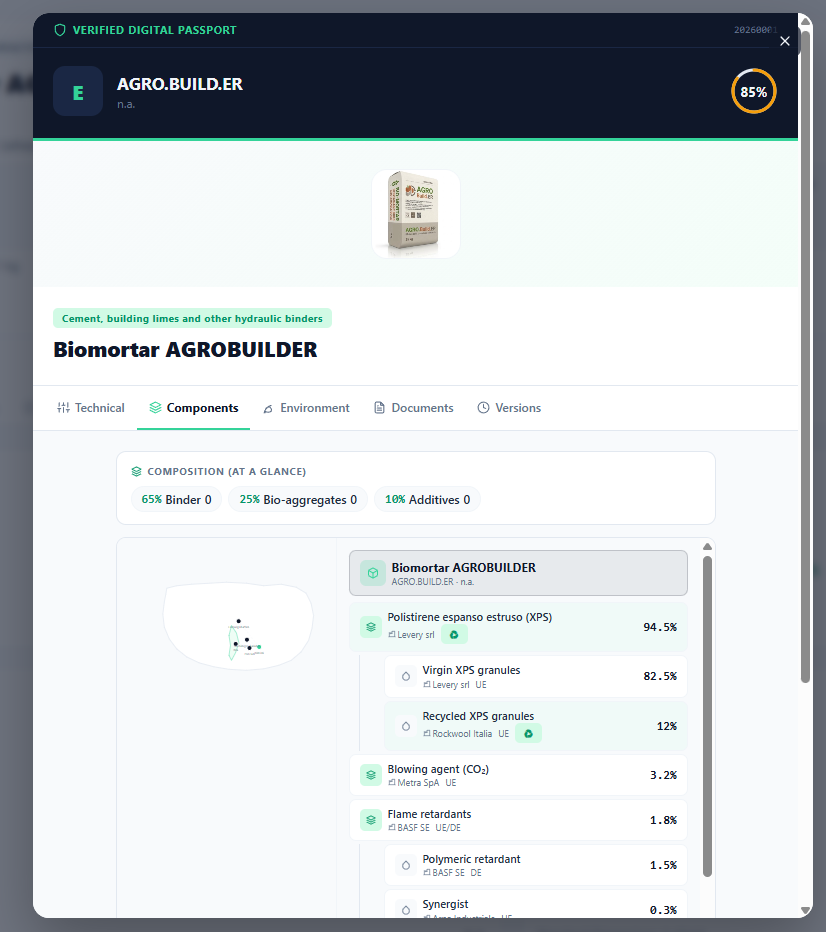
We at Levery are moving in the same direction. Starting as an applied research and development actor in the construction sector – with direct presence in product development phases, technical qualification and supply chain processes – we have built specific knowledge of what a construction component manufacturer actually needs to structure its product data in a compliant and useful way. Building on this expertise, we are developing DeePPy: a DPP platform designed for manufacturers without an internal IT team who need to prepare for ESPR and CPR obligations without starting from scratch. The approach is progressive – start with one product, build the data structure, scale over time – because we believe the digital product passport should be a working tool, not an additional bureaucratic burden.
The advantage is built before it becomes mandatory
The difference between those who will be ahead and those who will be behind will not be measured in the ability to fill in a compliance form. It will be measured in the quality of the data a manufacturer has already built over time – on its materials, on its environmental performance, on the behaviour of the product on site and beyond. The actors described in this article are building that quality today. For SME manufacturers operating in the building envelope and construction materials supply chain, the time to start is not when regulation becomes mandatory. It is now.

Stay informed
One email per month. R&D and innovation news for the construction industry.
No spam. Unsubscribe at any time.